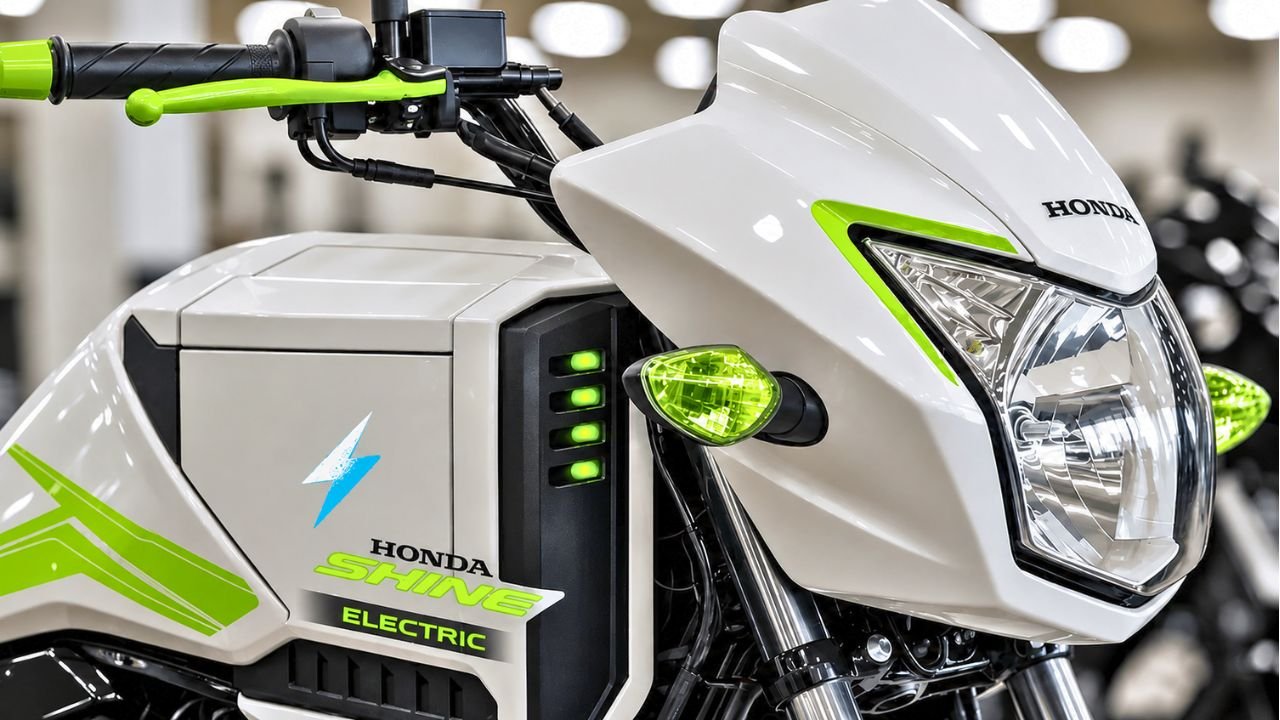
Honda Electric Shine 2027: If you have lived in India for any length of time, you know the Honda Shine. It sits outside tea stalls, offices and apartment blocks in almost every town. It is not flashy, but it starts every morning and rarely complains. So when talk began that Honda was building an electric version, a lot of riders sat up and paid attention.
The buzz around the Honda Electric Shine 2027 is hard to ignore. Reported figures include a range of around 256 km and a roughly 45-minute fast charge. Before we get into it, one honest note: Honda has not published official specifications yet. Everything below is based on patents, listings and industry expectations, so please treat the numbers as reported, not confirmed.
Honda Electric Shine 2027
The Honda Electric Shine, usually listed as the Honda Shine Electric, is an upcoming electric commuter motorcycle. Patents that surfaced in July 2025 suggested the bike will be based on the Honda Shine 100. That makes sense. Honda has spent decades refining the Shine’s proportions, seat height and ride comfort, and an electric version can borrow all of that.
The idea is simple. Take a bike people already trust, swap the petrol engine for a motor and battery, and keep the everyday usability. Listings describe it as an affordable electric motorcycle aimed at the mass-market commuter segment. That is a very different goal from a flashy performance EV, and it is probably the smarter one for India.
Honda Electric Shine 2027 Range: Is 256 km Realistic?
Range is the first thing every buyer asks about, and it is where you need to be careful with the claims.
The 256 km number is not out of thin air. Some listing sites show a range of about 252 km per charge for the Shine Electric. That is close to the figure in the headline. But other sources disagree. One estimate suggests a city-focused range of 100-120 km per charge. Another expects a real-world range of roughly 80-100 km from 3 kWh swappable batteries. Yet another listing claims up to 400 km.
When estimates range from 80 km to 400 km, none of them is solid. Here is a practical way to think about it:
- Claimed range is what the manufacturer measures under ideal test conditions. A 256 km claim, if it becomes official, would be this number.
- Real-world range is usually 20-35% lower once you add traffic, stop-start riding, a pillion passenger, hills and hot weather.
- Your range depends on your weight, tyre pressure and how aggressively you use the throttle.
So even if Honda claims 256 km, plan around something closer to 170-200 km in daily use. That is still more than enough for most commuters, who ride 30-50 km a day. You could go several days between charges.
The 45-Minute Fast Charge: What It Could Mean
The second headline figure is a 45-minute fast charge. No official source confirms it, so it should be treated as a rumour for now. If it does come true, here is why it matters.
Most affordable electric two-wheelers charge from a home socket in four to six hours. That is fine overnight but frustrating if you forget to plug in or need to head out unexpectedly. A fast-charge option that tops up a large part of the battery in under an hour changes that completely. You could grab a quick top-up during lunch and ride home with confidence.
Two things to watch when Honda confirms the details:
- What percentage does 45 minutes cover? “0-80%” and “0-100%” are very different promises.
- Where can you fast charge? A fast-charge claim is only as useful as the charging network behind it. Public fast chargers for two-wheelers are still thin outside big cities.
Honda also has another route here. Reports suggest the Shine Electric may use swappable battery packs, like the Honda Activa e. If that happens, you may be able to swap a drained pack for a charged one in a couple of minutes, which would be even faster than any plug-in charging.
Smart Features to Expect
Honda is not known for stuffing its commuter bikes with gadgets, and the Electric Shine is likely to stay practical. Based on current listings, here is what looks likely:
- Digital instrument cluster: Listings mention a digital cluster, LED headlamps, LED tail lights and a USB charging port. Expect clear readouts for speed, battery level and estimated range.
- LED lighting: Better visibility at night, and lower power draw than halogen bulbs.
- USB charging port: Handy for topping up your phone on the move.
- Self-start: No kick lever, just press a button.
- Gearless riding: One listing describes a gearless automatic transmission, which makes city riding far less tiring.
Bluetooth connectivity, ride modes, regenerative braking and app-based battery tracking would be nice extras. These have not been confirmed, so do not assume them until Honda’s spec sheet is out. One cost-saving possibility is that Honda may use a simple digital-analog cluster, drum brakes and twin rear shock absorbers. That would be a trade-off for a lower price.
Performance: Not a Speed Machine, and That’s Fine
The Shine has never been about thrills. One listing gives a top speed of 95 km/h and 45 Nm of torque, while another suggests 110 km/h. Either way, that is comfortably enough for city streets and highway stretches.
Electric motors also deliver torque instantly. Pull away from a traffic light and the Electric Shine should feel livelier than its petrol sibling off the line. Add the near-silent motor and the absence of engine vibration, and daily riding should feel noticeably smoother.
Expected Price in India
Price decides whether an EV becomes a mass-market success. Estimates vary widely here too. One listing expects an ex-showroom price of around ₹1,30,000. Another suggests a range of ₹64,900 to ₹83,800. That gap suggests the lower figure could reflect a battery-as-a-service or swappable-pack model, but this is speculation.
A fair expectation is somewhere between ₹1 lakh and ₹1.4 lakh ex-showroom, depending on the battery and variant. Remember that final on-road price depends on your state’s subsidies, registration charges and insurance.
Running Costs: Where Electric Really Wins
Even without official specs, the economics of an electric commuter are easy to see. One estimate puts monthly running costs at roughly ₹200-300 on electricity, compared with ₹1,000 or more for a petrol commuter. Over a year, that can add up to several thousand rupees saved on fuel alone.
Maintenance is lower too. There is no engine oil, no spark plug, no clutch and no chain-and-sprocket drama from a complex gearbox. Brake pads, tyres and the occasional general check are most of what you will need. The main long-term cost to consider is the battery, so look closely at the warranty Honda offers.
Launch Date: When Can You Buy It?
This is where patience is needed. Sources disagree here as well. One site expected a launch on 6 October 2026, but that date seems to have passed without a launch. Another listing now points to January 2028. Since the bike is called the Electric Shine 2027, an official reveal sometime in 2027 looks plausible, but nothing is confirmed.
The safest approach is simple. Do not book anything based on a rumoured date, and be wary of dealers asking for advance deposits on a model that has not been announced.
How Does It Compare With Rivals?
The electric commuter segment is getting crowded. Competitors mentioned in listings include the Oben Rorr EZ at ₹99,999-1.30 lakh with 175 km claimed range, and the Hop Oxo at ₹1.28-1.61 lakh with 140 km. If the Electric Shine truly delivers around 250 km at a similar price, it would clearly lead on range.
But Honda’s real advantage is not on a spec sheet. It is the dealer network, the resale value and the trust the badge carries. Many first-time EV buyers worry about service and parts availability. Honda has one of the widest service networks in the country, and that could be the deciding factor for cautious buyers.
Who Should Wait for the Honda Electric Shine?
It is a good fit if you:
- Commute 20-60 km daily in the city or between towns
- Want a familiar, low-maintenance bike with lower running costs
- Value brand trust and service availability over flashy features
- Have a place to charge at home or work
You might look elsewhere if you:
- Need a bike today, since launch timing is uncertain
- Want sporty performance or advanced connected features
- Regularly ride long highway distances without charging options
Final Verdict
The Honda Electric Shine 2027 has a lot going for it on paper: a trusted nameplate, a practical commuter formula, a reported range around 256 km, a rumoured 45-minute fast charge and sensible everyday features. But the key word is “reported”. The numbers floating around online are inconsistent, and Honda has not confirmed them.
If you are in the market, keep an eye on Honda’s official announcements and wait for the real spec sheet, the battery warranty and the final price. If those match the headlines, the Electric Shine could be one of the most sensible electric bikes for everyday Indian riders. If they do not, you will be glad you waited for facts instead of rumours.
FAQs
Is the Honda Electric Shine launched in India? No. As of November 2026, Honda has not officially launched it. All specs and dates are unconfirmed.
What is the expected range? Reports vary, with some listings showing about 252-256 km and others far lower. Wait for Honda’s official claim.
How long will it take to charge? Honda has not confirmed charging times. The 45-minute fast charge figure is unofficial.
What is the expected price? Estimates range from about ₹65,000 to ₹1.3 lakh, depending on the source and battery model.
Will it have swappable batteries? Some reports suggest so, similar to the Honda Activa e, but this is not confirmed.