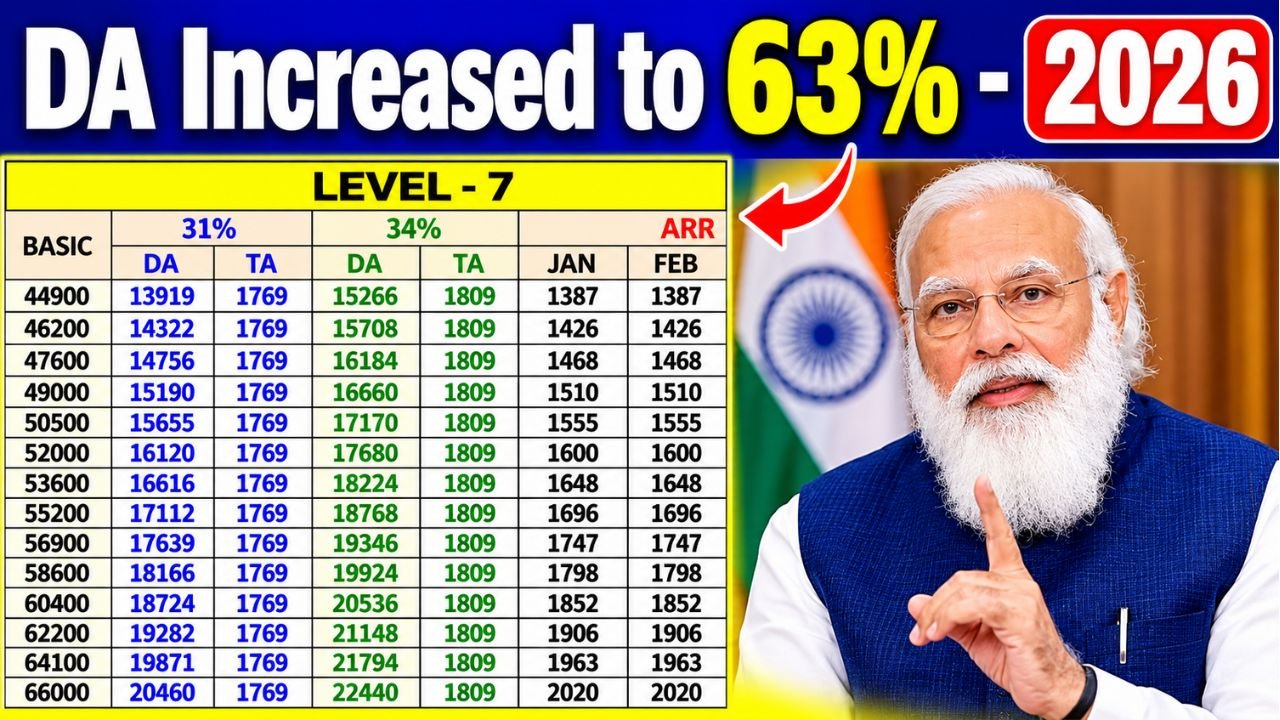
DA Increased to 63% in 2026: Every few months, lakhs of government employees and pensioners check one number on their payslip: Dearness Allowance. In October 2026, that number changed again. The Centre has raised DA and DR from 60% to 63%, and the new rate counts from 1 July 2026. That means a higher monthly salary from now on and a lump sum of arrears for the months already gone.
This guide explains what was approved, how to calculate your own increase, what arrears you can expect, and where the facts are still unclear.
DA Increased to 63% in 2026
| Point | Detail |
|---|---|
| Old DA rate | 60% (effective 1 January 2026) |
| New DA rate | 63% |
| Increase | 3 percentage points |
| Effective from | 1 July 2026 |
| Approved by | Union Cabinet, 28 October 2026 |
| Who benefits | About 48.54 lakh central employees and 68.71 lakh pensioners |
| Yearly cost to the government | ₹10,016.10 crore (DA and DR together) |
| Arrears period | July, August, September and October 2026 |
What exactly was approved
The Union Cabinet, chaired by Prime Minister Narendra Modi, approved an additional instalment of Dearness Allowance for central government employees and Dearness Relief for pensioners. The increase is 3% over the existing 60% of basic pay or pension, and it applies from 1 July 2026. Union Minister Ashwini Vaishnaw announced the decision, and the Department of Expenditure followed it with an Office Memorandum.
The government says the increase follows the accepted formula based on the recommendations of the 7th Central Pay Commission. In simple words, this is a routine revision. It is not a new pay commission and not a change in your basic pay.
What Dearness Allowance means
Prices rise over time, and a fixed salary buys less each year. DA is the government’s way of protecting the buying power of its employees. It is paid as a percentage of basic pay and is reviewed twice a year, with effect from 1 January and 1 July.
Pensioners receive the same protection under the name Dearness Relief, calculated on basic pension. DA applies to central and state government staff, public sector staff and pensioners. It does not apply to private sector employees.
Step by step: how to calculate your new DA
You only need your basic pay from your latest payslip. Do not include HRA, transport allowance or any other allowance.
- Find your basic pay. Example: ₹47,600.
- Calculate DA at the old rate. ₹47,600 × 60% = ₹28,560.
- Calculate DA at the new rate. ₹47,600 × 63% = ₹29,988.
- Find the monthly increase. ₹29,988 − ₹28,560 = ₹1,428. You can also use a shortcut: basic pay × 3%.
- Find the arrears. ₹1,428 × 4 months = ₹5,712.
If your basic pay changed between July and October, for example because of an annual increment or a promotion, repeat step 4 for each month with that month’s basic pay and add the results.
Monthly hike and arrears by pay level
The table below uses the entry-level basic pay of selected levels in the 7th CPC pay matrix. Your own basic pay may be higher depending on your years of service, so use your payslip for an exact figure.
| Pay Level | Basic Pay | DA at 63% | Monthly Increase | Arrears (4 months) |
|---|---|---|---|---|
| Level 2 | ₹19,900 | ₹12,537 | ₹597 | ₹2,388 |
| Level 4 | ₹25,500 | ₹16,065 | ₹765 | ₹3,060 |
| Level 8 | ₹47,600 | ₹29,988 | ₹1,428 | ₹5,712 |
| Level 11 | ₹67,700 | ₹42,651 | ₹2,031 | ₹8,124 |
| Level 12 | ₹78,800 | ₹49,644 | ₹2,364 | ₹9,456 |
Over a full year, the extra DA at 63% adds up to 36% of one month’s basic pay. For the Level 8 example, that is ₹1,428 × 12 = ₹17,136 per year. All figures here are gross, before tax and other deductions.
How arrears work for July to October 2026
The government announced the hike in late October, but the new rate counts from 1 July. For four months, you were paid DA at 60% when 63% was due. The government now owes you the difference.
The arrears formula is basic pay × 3% × 4. The number of months is four because July, August, September and October are covered. From November, the 63% rate simply becomes part of your regular monthly salary, so there are no separate arrears for November or later months.
Remember that this amount is added to your income of the year in which you receive it, which matters for tax.
When will the money arrive
This is the part where people get confused, so here is what is confirmed and what is not.
Confirmed: The Department of Expenditure order states that the arrears cannot be paid before the disbursement of October 2026 salary. The order does not name an exact date.
Expected but not guaranteed: Several news reports say the new rate and the four-month arrears are likely to reach employees with the November 2026 salary. Actual timing depends on how quickly your department’s pay and accounts office updates the payroll.
If you do not see the revision in your payslip, ask your Drawing and Disbursing Officer (DDO) or accounts section. Do not rely on rumours or social media dates.
Pensioners and Dearness Relief
Pensioners and family pensioners get DR at 63% from 1 July 2026. The method is the same as above, with basic pension replacing basic pay.
| Basic Pension | DR at 63% | Monthly Increase | Arrears (4 months) |
|---|---|---|---|
| ₹9,000 | ₹5,670 | ₹270 | ₹1,080 |
| ₹25,000 | ₹15,750 | ₹750 | ₹3,000 |
Pension revision is handled by the pension paying bank or office. If the new DR does not show up after a reasonable time, contact your bank branch or pension paying authority with your PPO number.
State government employees
The Cabinet decision is for central government employees and pensioners only. States decide their own DA and the way they pay arrears. Several states, including Uttar Pradesh, Rajasthan and Odisha, have announced 63% from 1 July 2026, but their payment rules are different.
For example, reports on the Uttar Pradesh and Rajasthan orders say the July to October amount is not paid in cash and is credited to the provident fund instead, while the higher rate comes in cash from the November salary. Other states may follow other rules or may still be at a different DA rate.
If you work for a state, read your own Finance Department order. Do not assume that the central government rate or the central arrears rule applies to you.
Tax on arrears
DA arrears are part of your salary income. When you receive four months of arrears together in one month, your taxable income for that year goes up. In some cases this can push part of your income into a higher tax slab.
Income tax law has relief provisions for salary arrears that relate to earlier periods, which spread the tax as if the money had been received in the years it belongs to. Whether you benefit depends on your income and tax regime. Ask your office accounts section or a tax professional before filing, and check the latest income tax rules for the correct forms.
What comes next
By the formula, DA is next due for revision with effect from 1 January 2027, and the rate will depend on inflation data. No figure has been announced for that revision. Any number you see online before an official announcement is only an estimate, so treat it with care.
The 8th Pay Commission is a separate subject. This 3% hike was made under the existing 7th CPC formula and does not change the basic pay structure.
Frequently asked questions
Is the DA hike to 63% official? Yes, for central government employees and pensioners. The Union Cabinet approved it in October 2026, and the Department of Expenditure issued the order.
From which date is the 63% DA applicable? From 1 July 2026.
How much will my salary increase every month? Your monthly increase is 3% of your basic pay. For a basic pay of ₹30,000, that is ₹900.
How many months of arrears will I get? Four months: July, August, September and October 2026.
Will HRA or travel allowance change because of this hike? This article does not cover other allowances. They follow their own rules, so check the latest orders for your city category.
Has DA been merged with basic pay? No. The 63% is paid as DA on top of basic pay.
Do state employees get the same hike? Not automatically. Each state government decides its own DA rate and arrears rules.
Is the 63% DA the same as the 8th Pay Commission? No. They are two different matters.
Disclaimer
This article is for general information only. DA rates, arrears timing and payment rules can differ by department and state, and they may change after publication. Please verify every figure with the latest Office Memorandum on the Department of Expenditure website (doe.gov.in) or with your DDO or accounts office before taking any financial decision. The calculations above are examples using entry-level basic pay and do not include tax or other deductions.